Thursday, September 27, 2012

Music can be Addictive


Music has been around for thousands of years and can be found all around us. Many people love listening to music, an activity which is reinforced by the listener himself based on its aesthetic reward. Scientists have long believed that our aesthetic appreciation for our favorite music is caused by activation of the reward pathways in our brain. Valorie Salimpoor, Mitchel Benovoy, Kevin Larcher, Alain Dagher, and Robert J Zatorre, of McGill University in Montreal, conducted a study using the neurochemical specificity of PET and interestingly, the temporal resolution of fMRI. Through PET scanning combined with a psychophysiological measure of autonomic nervous system arousal (chills) humans experience at peak emotional arousal, they discovered endogenous dopamine release in the striatum and decided to investigate the time course of this particular release. An fMRI investigation of the same music listening behavior to pleasurable stimuli and neutral stimuli was conducted using the voxels examined from the PET study. The researchers found a much stronger BOLD signal in the nucleus accumbens during peak arousal, likely indicating the presence of an emotional euphoric feeling. In addition, increased BOLD response was noted right before peak arousal in the caudate. The researchers explain this as anticipation of a euphoric emotional state, or reward prediction, and suggest that the reason music has been around for so long is that we “crave” the emotional peaks we experience while listening to it. However, greater investigation must be done to learn about the causes for this anticipation. As someone who loves music and always has a song in my head, I am interested in learning much more about how humans learn to appreciate aesthetic rewards. 

To read the paper published regarding this study, please read here.

Thursday, September 20, 2012

Mind Reading

iBrain reads brainwave activity and transmits it wirelessly back to a computerIf I could design a mind reading device, it would be one which would allow researchers to translate the electrical activity from a person’s brain recordings into his or her actual mental images in real time. This device would work somewhat like an EEG machine such that electrodes would be placed all over the scalp of the participant. Then, the machine would combine our knowledge of ERPs and electrical signals from areas allocated for visual processing to put together visual images of what is likely being imagined by the participant. The device seems like the next step beyond Dr. Philip Low’s iBrain (pictured to the left). The device is the first portable EEG headset which monitors brainwaves through a single channel and transmits them back wirelessly to a computer to aid communication and help with monitoring apnea and drug trials. (See here for article with more information.) While the device I hypothesized might seem unusual and difficult to create, it would have important implications for those studying night terrors and sleep disorders, PTSD, and disorders in which human beings find themselves paralyzed and only able to communicate by pointing to a screen.

Wednesday, September 12, 2012

New Perspectives

New Perspective Senior Living Community in Brookfield, WI

There’s an old saying that says that you never know how much you need something until it’s gone. In life, this can hold true for relationships with loved ones or opportunities that pass us by. However, when I began volunteering at New Perspective Home, a residence facility for patients with Alzheimer’s disease, I felt keenly aware of the far-reaching influences of memory and just how tragic it can be when it is decaying. The facility had two group homes, one with high-functioning individuals and one with patients who had deteriorated considerably. I volunteered on a consistent basis and was used to having to remind people of my name or to listen to the same stories being told each time. But, it was heart-breaking visiting patients when they were at a complete loss as to what was going on in the world around them and could not remember the loved ones who would visit them, let alone the strangers whom were living next door. What is the role of memory in forming our identity and perspective of the world? How does Alzheimer's and other forms of dementia influence our interactions with others? What kinds of treatments and interventions can be used when the mind gradually begins to slip into a fog? I learned to appreciate the tactics caregivers would use to help patients exercise their memories. Suddenly, daily singing of songs from before my time took on a new meaning, as did the basic card games and drawing activities. All of these were meant to help jog patient's memories and keep them active. Experiences like these taught me about the true value of memory and the mind, and just how integral research into brain injuries and disorders can be to the lives of so many!

Thursday, September 6, 2012

Much to Be Learned


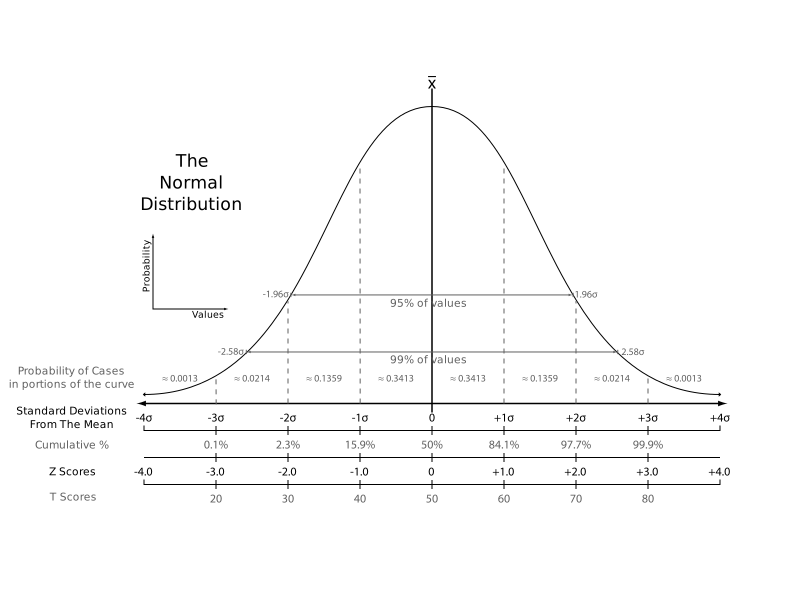
I was enrolled in a research methods class at Duke with Alison Koenka this summer and learned so much about measurement, validity, reliability, and the different between-group and within-group research designs commonly used in psychology and neuroscience. Thus, I feel very comfortable with experiments. However, despite having taken a statistics course already at Duke, I am still confused by statistical methods and find it difficult to make sense of them. At a basic level, I understand that there are descriptive and inferential statistics, and both are necessary for helping researchers organize, summarize, and interpret the data in a way that some sense can be made from it. I also remember the theory behind null hypotheses testing and do find the alpha significance level of a comparison distribution to be important in separating research that reports true effects in a population from research that does not. However, though I am familiar with the normal distribution depicted below, I find myself lost in the details, especially with regard to the statistical theory behind the F and t distributions. In addition, while I do know about type I and type II errors, I do not understand what ‘power’ is and how some evidence has greater power than others. 
Despite my previous knowledge of research design and statistics, I still find journal articles confusing as well. Many times, articles use methods with which I am not familiar. For this reason, I am confused by the graphs and tables provided describing the experiment’s data. For example, I still do not understand representations indicating EEG or TMS data. However, it is my hope that greater exposure to methods used by researchers in psychology and neuroscience will help me understand these graphs and images better.